
If you want to delve into the historical beauty of Bergamo, Piazza Vecchia and Piazza Duomo are two places you absolutely mustn’t miss. These captivating locations, nestled in the heart of Bergamo’s old town, are rich in history, culture, and architectural splendor.
In this article, I will guide you through the main monuments you can admire in these two historic squares.
Piazza Vecchia: A Dive into Bergamo’s History
This is the main square in the historic part of Bergamo. The center of the city was located here until a few centuries ago when it was “moved” to the lower part where it is today.
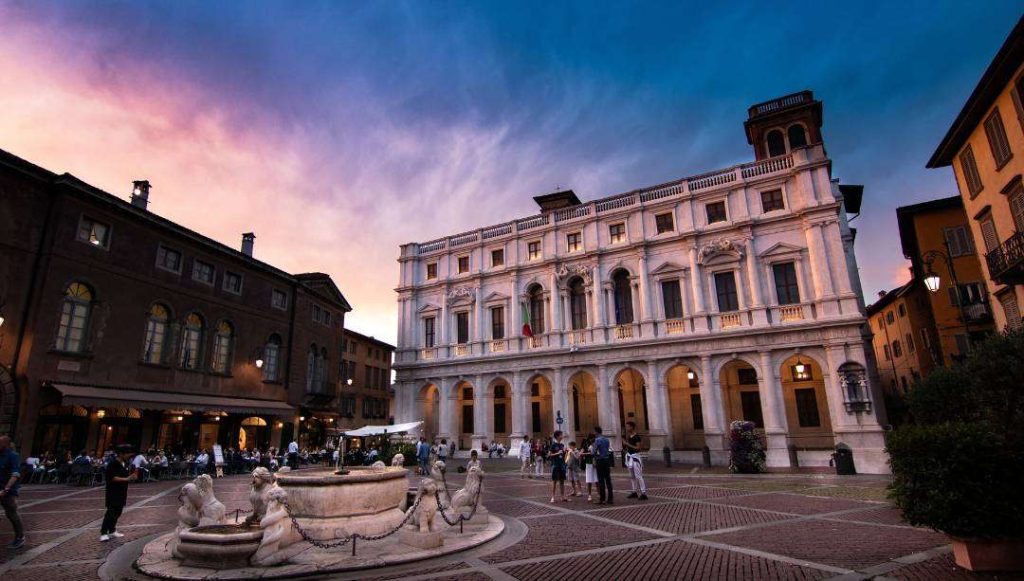
Palazzo Nuovo (Official website)
One of the first landmarks that catches your eye when you arrive at Piazza Vecchia is the magnificent Palazzo Nuovo.
It required three centuries to construct this magnificent edifice. The construction initiative commenced in 1604 and reached its culmination in 1928. For a span of three centuries, this grand Palace was utilized as the administrative center of Bergamo until the year 1873.
Since 1928, a portion of the structure has been home to one of Italy’s most celebrated libraries, known as the “Civica Angelo Mai.” This esteemed library meticulously preserves ancient parchments, incunabula, codices, and invaluable musical compositions.
Within the “Tassiana Hall”, visitors can behold the remarkable globes created by Vincenzo Maria Coronelli, the cosmographer of the Venetian Republic. Crafted in the years 1688 and 1692, these globes possess a circumference of 3 meters and consist of 50 illustrated sheets. Upon observing them, one might ponder whether they truly differ from their modern-day equivalents.
Schedules
Mon – Fri | 8.45 – 17.30
Sat | 8.45 – 13.00
Sun and holiday | Closed
Ticket: Free entrance

Fontana del Contarini
The Contarini’s fountain is a small gem located in the heart of the square. This fountain, dating back to the 17th century, adds to the charm of the square.
Interesting fact: At present, the Contarini Fountain primarily serves an aesthetic purpose. However, upon its initial construction, it functioned as a vital water source for household consumption and played a role in alleviating water scarcity.
Torre del Campanone (Official link)
Nestled within the center of Piazza Vecchia, you’ll encounter the Civic Tower, also referred to as the Campanone. Rising to an impressive height of 52.76 meters, it provides a mesmerizing panoramic vista of the historic town. At its summit, accessible by a staircase comprising 230 steps or more conveniently by an elevator, you’ll discover Lombardy’s most extensive bell.
Interesting fact: every single day, at 10 p.m. the Campanone resounds with one hundred (100 !) chimes, serving as a timeless symbol of the city’s gates being closed along the protective walls during the period of Venetian rule.
Schedules
Mon | Closed
Tue-Fri | 10-18
Sat – Sun and holiday | 10-19
Ticket: 5€

Palazzo della Ragione
Beneath the historic Administration Headquarters lies a captivating display of medieval architecture. These structures, steeped in history and elegance, harmoniously blend practical functionality with beauty.
Throughout its extensive existence, the Palace has endured damage and reconstruction on multiple occasions. It has served a multitude of purposes, even transforming into a theater and a library at different junctures. Today, after eight centuries, the Palace stands as a testament to Bergamo’s rich artistic and historical heritage, frequently hosting various art exhibitions.
Interesting fact: Have you wondered about the origin of its name? The Palazzo della Ragione was one of Italy’s earliest “Commune Halls,” constructed nearly a millennium ago to facilitate public meetings within the city.
Nonetheless, the present designation traces back to the Venetian dominion, during which the palace functioned as a courthouse. Judges here presided over legal disputes among citizens and issued verdicts based on “ragione,” the Italian word for reason. This courthouse was notably elegant, as evidenced by the frescoes adorning its interior.
Schedules
Mon | Closed
Tue-Fri | 10-18
Sat – Sun and holiday | 10-19
Ticket: Free entrance
The sundial

Outside the “building “Palazzo della Ragione”, beneath the loggia, a further surprise awaits you: the sundial crafted over 200 years ago in 1798. When a beam of sunlight intersects with the sun clock etched into the marble floor, it continues to precisely mark the date and local noon.
Piazza Duomo: Treasures of Art and Culture

Cappella Colleoni
The Cappella Colleoni is one of Bergamo’s most extraordinary Renaissance works of art. This mausoleum, dedicated to the condottiero Bartolomeo Colleoni (that is not related to Don Vito Corleone, the one from The Godfather) “, is renowned for its remarkable architecture and intricate decorations. Entrance is free, but donations for restoration are appreciated.
Interesting fact: On the left side of the entrance gate of the Colleoni Chapel is the condottiere’s coat of arms with three…. testicles. The family’s surname derives precisely from the Latin word “coleus” (testicle) and they were so proud of it in the family that it became their official symbol.

Rubbing this symbol is said to bring good luck (that’s why you see it so shiny). I don’t know if this is true but it doesn’t cost anything to try!
Schedules
Mon | Closed
Tue-Fri | 9.30-12.30 / 14.00 – 16.30
Sat – Sun and holiday | 10-19
Ticket: Free entrance
Battistero (Baptistery)
Bergamo’s Battistero is an example of Romanesque architecture and a place of significant historical importance. Constructed in 1340 within the Santa Maria Maggiore Church, situated in the Città Alta, it resided in that location until 1661. Subsequently, it underwent two disassemblies and reconstructions, resulting in various alterations and revisions. The final relocation took place between 1898 and 1899 when it was transferred to the western side of the Piazza del Duomo in the Upper Town. There, it was reassembled, adopting a neo-Gothic style.

Santa Maria Maggiore
In the early years of the 1100s, a devastating plague swept through Europe, resulting in widespread death and suffering. Faced with this calamity, the residents of Bergamo made a solemn appeal to the Virgin Mary for her intercession. They pledged to construct a church in her honor if she would shield them from the ravages of the disease. True to their word, in 1137, the people of Bergamo commenced the construction of the Basilica of Santa Maria Maggiore on the Piazza del Duomo, situated in the Upper Town.
The entrance is located to the left of the Colleoni Chapel, and although from the outside it doesn’t look that impressive I highly recommend taking a look inside: the church is really wonderful and super decorated!
Schedules
Mon – Sat | 9.00 – 12:30 / 15.00 – 17.00
Sun and holiday | 9.00 – 13:00 / 15.00 – 18.00
Ticket: 5€ adults and 2€ for young adults (14-25 years of age) and over-70

Duomo of Bergamo (Saint Alexander’s Cathedral)
The Bergamo Cathedral is another place of worship not to be missed.
Several recent excavations have uncovered the remains of the first place of worship dating back to the 5th century. In the 8th century the church was dedicated to St. Vincent, and only in 1704 was it dedicated to St. Alexander.

Interesting fact: Above the main door you may see a blue logo with yellow symbols: these are papal symbols (the hat, the staff, the cross).
One of the most important people originating from the Bergamo was indeed a pope! From 1958 to 1963 Pope John XXIII led the church under the nickname “Good Pope.” Inside the church, to the right of the altar, you can also find a small chapel dedicated to him.
Schedules
Mon – Fri | 7.30 – 12.30 / 15.00 – 18.30
Sat – Sun and holidays | 7.00 – 19.00
Ticket: Free entrance
 EN
EN  IT
IT  ES
ES  DE
DE